Nasdaq is moving closer to enabling blockchain-based securities trading following recent regulatory clarity from U.S. authorities, marking a notable shift in how traditional financial markets may operate. The development comes days after U.S. regulators outlined clearer classifications for digital assets, reducing uncertainty that had slowed institutional adoption. While no full rollout timeline has been confirmed, early signals suggest tokenized equities could soon move from concept to implementation. Markets have yet to fully react, but analysts say the long-term implications are significant.
Table of Contents
Key Takeaways
- Nasdaq is progressing toward tokenized securities infrastructure after regulatory clarity
- Tokenized stocks could enable 24/7 trading and broader global access
- The move strengthens the Real World Assets (RWA) narrative in crypto
- Market reaction remains muted, but long-term structural impact is substantial
Nasdaq’s Blockchain Shift Signals Structural Change
Nasdaq’s latest move reflects a broader shift within global financial markets toward blockchain-based infrastructure. The exchange has been actively exploring digital asset integration for several years, but regulatory uncertainty in the United States had limited progress.
That landscape is now changing.
Recent guidance from U.S. regulators has clarified how different categories of crypto assets should be treated, particularly distinguishing between commodities and securities. This clarity has opened the door for institutions to revisit previously stalled blockchain initiatives.
Put simply, the regulatory barrier that once slowed adoption is beginning to ease.
From Exploration to Implementation
Nasdaq has previously experimented with blockchain solutions, including market infrastructure and settlement systems. However, the current push goes further, toward enabling tokenized versions of traditional financial instruments.
According to reporting from Reuters and Bloomberg, regulatory alignment is increasingly allowing exchanges to test and deploy blockchain-based systems within existing compliance frameworks.
While Nasdaq has not announced a full-scale launch, the direction is clear: tokenization is moving closer to reality.
Understanding Tokenized Securities
What Are Tokenized Stocks?
Tokenized stocks are blockchain-based representations of traditional equities. Each token is typically backed by a corresponding real-world share, allowing investors to gain exposure through digital platforms.
In plain terms, instead of buying shares through a broker, investors can hold a digital token that reflects ownership of that asset.
Core Advantages of Tokenization
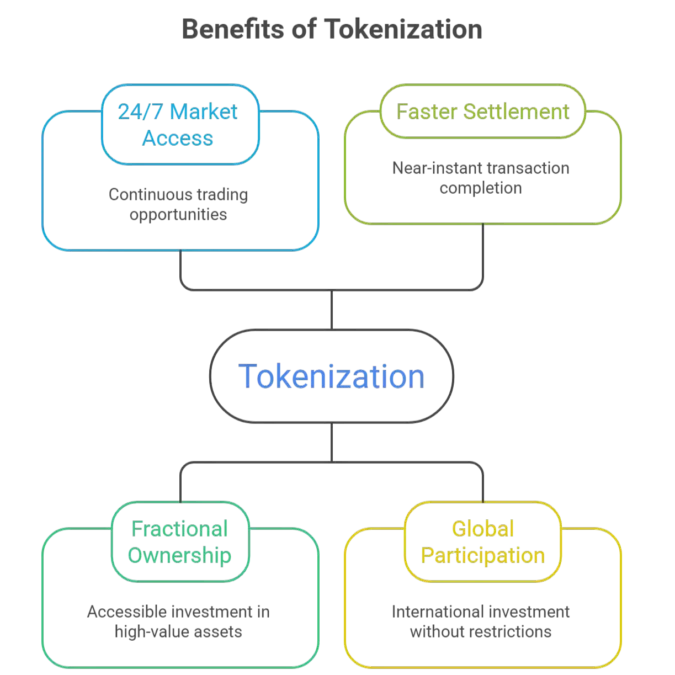
24/7 Market Access
Traditional stock markets operate within fixed hours. Tokenized markets could function continuously, similar to cryptocurrency exchanges.
Fractional Ownership
High-value stocks can be divided into smaller units, lowering the barrier to entry for retail investors.
Faster Settlement
Blockchain-based systems can reduce settlement times from days to near-instant execution.
Global Participation
Investors from different regions may access tokenized assets without traditional geographic restrictions, depending on regulatory frameworks.
Why This Move Extends Beyond ETFs
The approval of crypto exchange-traded funds (ETFs) marked a major milestone by integrating digital assets into traditional finance. However, tokenization represents a different shift.
ETFs bring crypto into existing systems. Tokenization redefines those systems.
Nasdaq’s involvement suggests that blockchain may not remain an alternative infrastructure—it could become part of the core market architecture.
Industry Perspective
Financial analysts increasingly view tokenization as a long-term efficiency upgrade rather than a speculative trend.
As Larry Fink, CEO of BlackRock, noted in a 2024 shareholder letter:
“The next generation for markets, the next generation for securities, will be tokenization.” — Larry Fink, CEO, BlackRock
Although the statement predates Nasdaq’s latest move, it reflects a growing institutional consensus.
The Rise of Real World Assets (RWA)
Tokenized equities are part of a broader category known as Real World Assets (RWA), which refers to bringing traditional assets onto blockchain networks.
This includes:
- Equities
- Bonds
- Real estate
- Commodities
According to data from industry platforms such as Binance Research and CoinDesk, RWA has become one of the fastest-growing segments in digital assets.
Why RWA Is Gaining Attention
Bridging Two Financial Systems
RWA connects traditional finance with blockchain, enabling interoperability between the two.
Expanding Market Size
By bringing trillions of dollars in traditional assets on-chain, tokenization significantly expands the total addressable market for crypto infrastructure.
Institutional Alignment
Unlike earlier crypto narratives, RWA aligns closely with institutional interests such as efficiency, compliance, and transparency.
Market Impact and Investor Sentiment
Despite the significance of Nasdaq’s move, crypto markets have shown limited immediate reaction.
Bitcoin and major altcoins remain influenced by macroeconomic factors, including interest rate expectations and inflation data.
However, structural developments often take time to reflect in price action.
Institutional vs Retail Perspective
Institutions
For institutions, tokenization offers operational efficiency and reduced costs. It also simplifies cross-border transactions and settlement processes.
Retail Investors
For retail participants, tokenization may increase access to global financial markets, particularly through fractional ownership and extended trading hours.
Regulatory Context Remains Key
Nasdaq’s progress is closely tied to evolving regulatory frameworks.
Recent guidance from U.S. regulators has clarified that certain digital assets fall outside traditional securities definitions, while tokenized financial instruments may still be regulated under existing securities laws.
This distinction is critical.
It allows innovation to continue while maintaining oversight for assets tied directly to traditional financial instruments.
This development follows the regulatory shift detailed in our earlier coverage:
👉 https://coinspectra.in/sec-crypto-classification-market-structure-shift/
That framework provides the foundation for institutions like Nasdaq to move forward with blockchain integration.
Challenges and Open Questions
Despite growing momentum, several challenges remain:
- Regulatory fragmentation across jurisdictions
- Custody and asset verification mechanisms
- Liquidity distribution across platforms
These issues will likely shape how quickly tokenized markets scale.
Why This Matters
This shift signals a transition from experimental blockchain use cases to real financial infrastructure, potentially reshaping how assets are issued, traded, and settled globally.
What This Means for Traders
- Watch the RWA sector, which may gain sustained institutional interest
- Expect gradual integration rather than immediate market reaction
- Monitor regulatory developments closely, they will define adoption speed
- Infrastructure tokens may benefit more than speculative assets
Conclusion
Nasdaq’s move toward tokenized securities reflects a broader evolution in global finance. While still in early stages, the shift indicates that blockchain is increasingly being considered as foundational infrastructure rather than an alternative system. The pace of adoption will depend on regulatory clarity and market readiness, but the direction is becoming clearer.
Disclaimer: The information provided in this article is for informational purposes only and does not constitute investment advice. Always do your own research before making financial decisions. Follow us for more updates from coinspectra.in

Potaraju Ramesh
Potaraju Ramesh is the Founder and Lead Market Analyst at CoinSpectra.in, an independent digital publication focusing on cryptocurrency and Web3. Since 2017, he has been analyzing market cycles, on-chain data, and Indian regulatory frameworks. His editorial approach is built on transparency and data-driven neutrality, providing readers with the context needed to understand complex digital asset shifts.