When discussions about blockchain adoption shift from exchanges and retail traders to clearing houses and settlement utilities, the tone changes. That is precisely what has happened with the recent attention surrounding potential interoperability between Ripple’s infrastructure and the Depository Trust & Clearing Corporation.
To understand why this matters, it is necessary to first understand what DTCC represents in global finance.
The Role of DTCC in Global Markets
The Depository Trust & Clearing Corporation is not a trading platform. It does not set prices or promote assets. Instead, it performs one of the most critical functions in financial markets: clearing and settling trades after they are executed.
Every time a stock is bought or a bond is sold in the United States, DTCC’s infrastructure ensures that ownership records are updated and payments are completed. It reduces counterparty risk, manages collateral, and ensures that trillions of dollars in securities transactions close without systemic disruption.
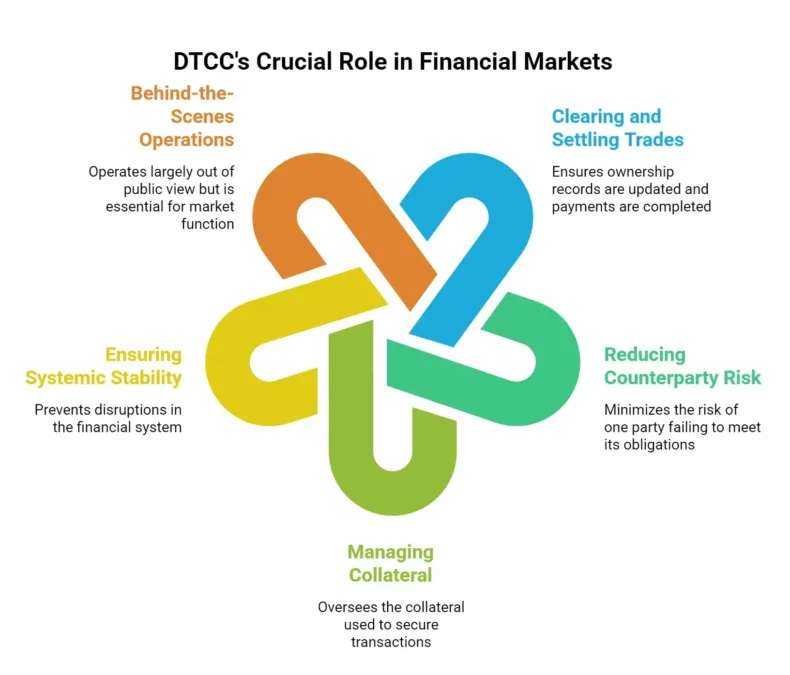
In simple terms, DTCC is the plumbing behind Wall Street. It operates largely out of public view, but markets cannot function without it.
When blockchain infrastructure begins interacting with this layer of finance, the implications extend far beyond token speculation.
Where Ripple Fits Into the Equation
Ripple has spent years positioning its technology stack for institutional use. Its ecosystem, anchored by the XRP Ledger (XRPL), focuses on cross-border payments, liquidity management and increasingly, tokenized asset infrastructure.
Unlike retail-focused crypto platforms, Ripple’s strategy has centered on working with financial institutions, payment providers and enterprise clients. That makes any reported integration or compatibility with DTCC infrastructure particularly noteworthy.
The significance is not about price. It is about infrastructure.
Related: Ripple’s RLUSD Stablecoin Hits $1.5B Market Cap, Enters Top 50
Why Settlement Efficiency Matters
Traditional settlement processes often operate on a T+1 or T+2 basis, meaning trades are finalized one or two business days after execution. This delay exists because multiple intermediaries validate, reconcile and confirm transaction details.
That layered process reduces risk but introduces latency and cost.
Distributed ledger technology offers a different model. Transactions can be validated through cryptographic consensus mechanisms, creating synchronized records across participants in near real time.
If blockchain rails can operate alongside DTCC’s clearing framework, settlement timelines could shorten under controlled conditions. Even incremental efficiency improvements in large-scale markets translate into meaningful capital optimization.
For institutions managing billions in daily exposure, reduced settlement friction improves liquidity management and lowers operational overhead.
Cost Structures and Intermediary Layers
Clearing and settlement systems evolved in an era before real-time digital infrastructure. As a result, multiple custodians, correspondent banks and reconciliation entities may be involved in complex transactions, particularly in cross-border contexts.
Blockchain-based settlement frameworks propose a more consolidated validation model. Fewer reconciliation points can mean fewer operational costs and reduced administrative complexity.
If interoperability with DTCC systems allows institutions to selectively deploy distributed ledger rails where efficient, the impact could be structural rather than cosmetic.
This is why industry analysts focus on integration at the clearing layer rather than exchange announcements.
Institutional Credibility and Regulatory Alignment
DTCC operates under stringent regulatory oversight. Any form of technical alignment requires compliance scrutiny, security assessments and operational resilience testing.
For blockchain infrastructure providers, this represents validation at the highest institutional tier.
Financial institutions tend to adopt new systems cautiously. When distributed ledger technology becomes compatible with established clearing utilities, it lowers psychological and operational barriers to broader experimentation.
Such integration signals that blockchain is not being positioned as a disruptive replacement, but as a complementary infrastructure layer.
A Broader Shift Toward Hybrid Finance
Global capital markets are exploring tokenization of real-world assets, including treasuries, private credit instruments and money market products. These initiatives require credible post-trade settlement architecture.
A hybrid model, where tokenized assets interface with established clearing systems, appears more plausible than a wholesale migration to entirely new rails.
Ripple’s proximity to DTCC-linked processes places it within that evolution. It reflects convergence rather than confrontation between traditional finance and digital ledger systems.
Also Read: AI Gains Financial Autonomy as Machine Economy Enters Structural Shift
What It Does Not Mean
It does not mean immediate transformation of securities markets. Nor does it imply automatic adoption of a specific cryptocurrency as a settlement asset.
Infrastructure transitions unfold gradually. Pilot programs, phased rollouts and controlled use cases typically precede systemic shifts.
The relevance lies in direction, not immediacy.
Why Market Observers Are Watching Closely
When blockchain technology intersects with systemically important financial utilities, it marks a different stage of maturity. The conversation moves beyond token listings and venture funding rounds toward capital market architecture.
If integration deepens over time, it could influence how securities settle, how liquidity is managed and how tokenized assets scale within regulated frameworks.
Also Read: MicroStrategy Adds 3,015 BTC, Holdings Reach 720,737
That is why the Ripple–DTCC connection has captured attention. Not because of speculation, but because it touches the structural foundation of modern finance.
This article is for informational purposes only and does not constitute financial, investment, or legal advice.

Potaraju Ramesh
Potaraju Ramesh is the Founder and Lead Market Analyst at CoinSpectra.in, an independent digital publication focusing on cryptocurrency and Web3. Since 2017, he has been analyzing market cycles, on-chain data, and Indian regulatory frameworks. His editorial approach is built on transparency and data-driven neutrality, providing readers with the context needed to understand complex digital asset shifts.