
India’s Finance Bill 2026 completes a long-anticipated shift in crypto regulation, moving the system decisively from voluntary self-reporting to automated, data-driven enforcement. The framework introduces recurring reporting penalties, tightens foreign asset disclosure requirements, and integrates crypto activity into India’s broader financial surveillance infrastructure.
Effective April 1, 2026, crypto compliance is no longer shaped by intention or disclosure quality. It is shaped by data matching, identity verification, and cross-border reporting.
What You Need to Know:
- Section 509 mandates transaction-level reporting by exchanges, backed by daily penalties
- Offshore crypto holdings must be disclosed under Schedule FA, regardless of profit or loss
- Lifestyle spending and banking activity are now actively cross-checked with crypto income
- A six-month amnesty window offers limited relief before full enforcement intensifies
From Tax Policy to Enforcement Architecture
Since the introduction of the 30% crypto tax and 1% TDS in 2022, India’s approach relied primarily on deterrence. That strategy produced revenue but also pushed a significant share of domestic trading volume offshore.
Finance Bill 2026 addresses that leakage directly.
Rather than chasing profits after the fact, the government has constructed an enforcement architecture that tracks who trades, where assets are held, how funds move, and whether lifestyle spending aligns with reported income.
Put simply, crypto is now regulated like a high-risk financial instrument, not a speculative novelty.
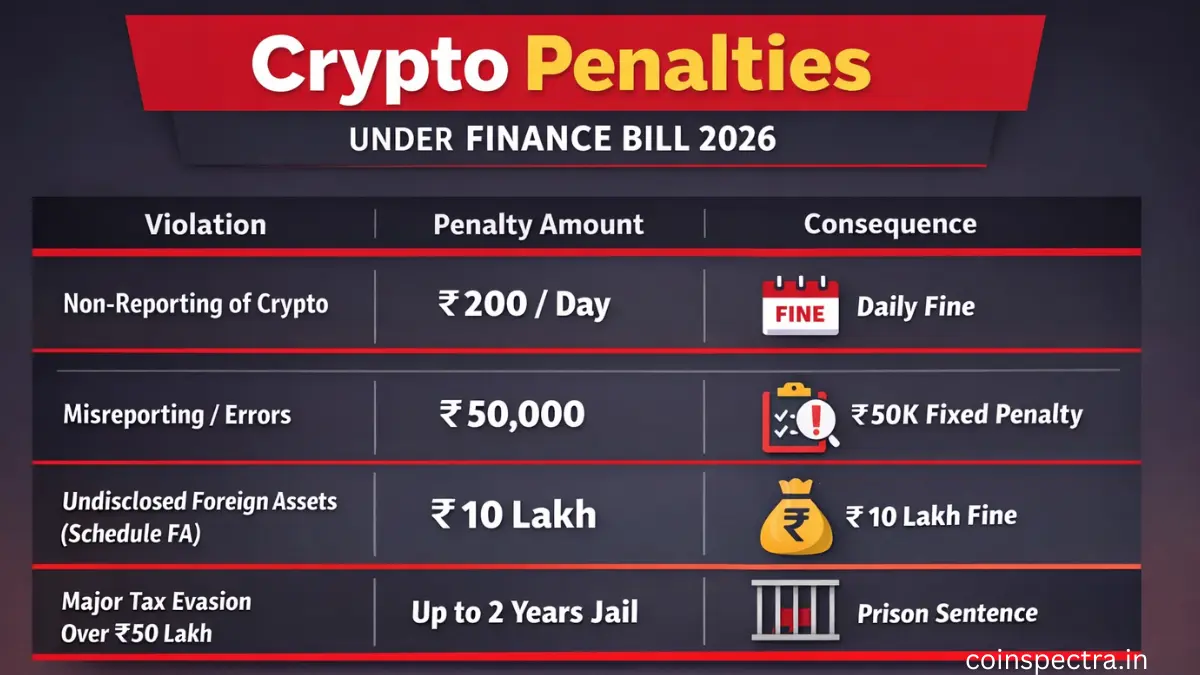
The Core Penalty Structure Under Finance Bill 2026
Visual summary of penalties introduced under Finance Bill 2026.
Why this matters:
The system no longer distinguishes between delay and evasion at the reporting level. Every missed or incorrect data point carries a measurable financial cost.
Section 509: Why Exchanges Now Drive Enforcement
Section 509 introduces mandatory reporting obligations for Virtual Digital Asset (VDA) service providers, including:
- Indian crypto exchanges
- FIU-registered foreign exchanges serving Indian users
- Certain custodians and intermediaries
These entities must submit detailed transaction statements to tax authorities. The ₹200-per-day penalty is designed to eliminate reporting gaps, not to raise revenue.
As a result, exchanges now have a direct incentive to:
- Reconcile user data aggressively
- Flag inconsistencies early
- Freeze or restrict accounts where reporting risk exists
Self-reporting is no longer the primary record. Exchange-reported data is.
The Global Layer: CARF and Cross-Border Crypto Data
India has aligned its crypto reporting strategy with the OECD’s Crypto-Asset Reporting Framework (CARF).
Key Timeline:
- 2026: Mandatory data aggregation year
- April 1, 2027: Cross-border data exchange begins across 40+ jurisdictions
Under CARF, foreign exchanges report Indian user data to their home regulators, which then transmit it to Indian authorities. Combined with Section 509, this creates a closed reporting loop.
Offshore custody is no longer opaque. It is delayed visibility at best.
Identity Controls: Ending Mule Accounts and Proxy Trading
How Indian crypto exchanges verify trader identity under the 2026 enforcement framework.
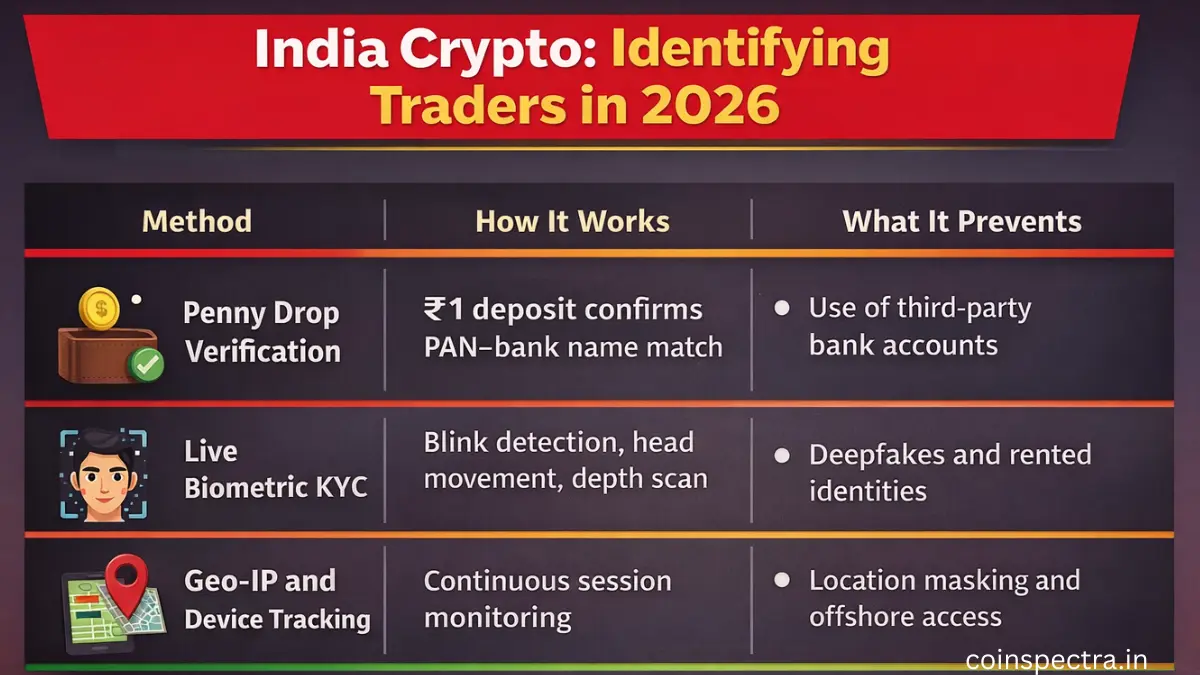
The goal is straightforward: one trader, one PAN, one audit trail.
Lifestyle Surveillance Through SFT Reporting
Crypto enforcement does not start with blockchain data. It often starts with spending.
Banks and financial institutions report high-value activity under the Statement of Financial Transactions (SFT) framework.
Table 3: SFT Red Flags That Trigger Scrutiny
| Activity | Reporting Threshold |
|---|---|
| Cash deposits | Above ₹10 lakh per year |
| Credit card cash payments | Above ₹1 lakh |
| Foreign travel or forex spends | Above ₹2.1 lakh |
| Cash gifts received | Above ₹50,000 |
| Single-day cash receipt | Above ₹2 lakh |
| Investments in shares or mutual funds | Above ₹10 lakh |
If these markers exceed declared crypto income, the excess may be treated as unexplained income, triggering reassessment.
Schedule FA: The Most Common Compliance Failure
Schedule FA requires disclosure of all foreign assets, including crypto.
Table 4: Common Misconceptions vs 2026 Reality
| Misconception | Reality |
|---|---|
| “I made a loss, so I don’t need to report” | Losses do not remove disclosure obligations |
| “Only INR cash-outs matter” | Ownership, not conversion, triggers reporting |
| “Hardware wallets are private” | Offshore custody counts as a foreign asset |
| “No TDS means no trail” | Banking, exchange, and SFT data fill gaps |
The ₹10 lakh penalty applies to non-disclosure itself, not to profits.
The Amnesty Window: A Narrow Exit Before Full Enforcement
The Foreign Assets of Small Taxpayers Disclosure Scheme provides a one-time opportunity to correct past omissions.
Table 5: Amnesty vs Non-Compliance Cost
| Scenario | Financial Outcome |
|---|---|
| Declare assets up to ₹5 crore | ₹1 lakh fixed fee |
| Declare undisclosed income up to ₹1 crore | 30% tax + 30% penalty |
| Ignore and get detected later | ₹10 lakh penalty + audit exposure |
Once the window closes, regular penalties apply without relief.
Why This Matters
Finance Bill 2026 integrates crypto into India’s permanent financial surveillance framework. For market participants, transparency is no longer optional, it is enforced by design.
What This Means for Traders
- Offshore exchanges no longer provide anonymity
- Schedule FA accuracy now matters more than tax optimization
- Exchange-reported data overrides self-declared records
- Early compliance is materially cheaper than post-audit correction
Conclusion
India’s crypto market is not being shut down. It is being formalized under a compliance-first model. Finance Bill 2026 removes invisibility from the system and replaces discretion with data.
For traders and long-term holders alike, survival in this environment depends on documentation, reconciliation, and timely disclosure.
Frequently Asked Questions:
Q: What changed for crypto investors under Finance Bill 2026?
A: India has moved from voluntary crypto reporting to system-driven enforcement.
Q: What is the ₹200 per day crypto reporting penalty?
A: It applies when required crypto transaction data is not reported on time.
Q: Do I need to report crypto held on foreign exchanges or hardware wallets?
A: Yes, offshore crypto holdings must be disclosed under Schedule FA.
Q: Does the ₹10 lakh penalty apply even if I made no profit?
A: Yes, the penalty applies to non-disclosure itself, not profits.
Q: What is the Foreign Assets Disclosure Scheme announced in 2026?
A: It allows limited-time voluntary disclosure of undisclosed crypto assets.
Disclaimer:
The information provided is for informational purposes only and does not constitute investment or legal advice. Always do your own research before making financial decisions. Follow us for more updates from CoinSpectra.in
You May Also Read: Bitcoin Miners Power Down as Losses Mount in 2026, Triggering a Network Reset

Potaraju Ramesh
Potaraju Ramesh is the Founder and Lead Market Analyst at CoinSpectra.in, an independent digital publication focusing on cryptocurrency and Web3. Since 2017, he has been analyzing market cycles, on-chain data, and Indian regulatory frameworks. His editorial approach is built on transparency and data-driven neutrality, providing readers with the context needed to understand complex digital asset shifts.