
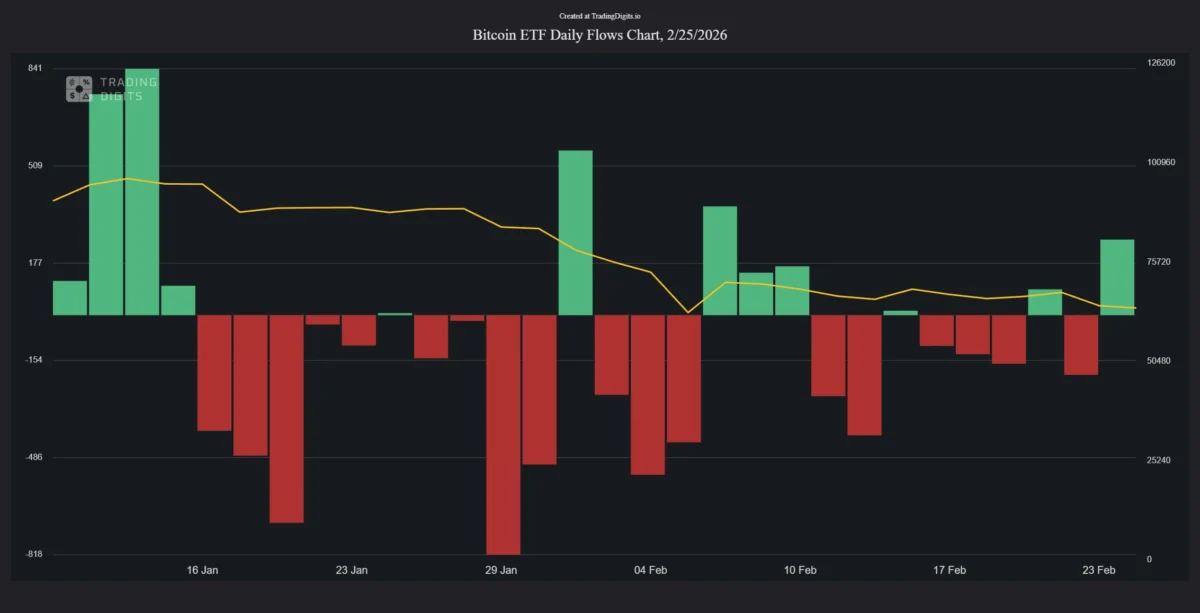
Bitcoin climbed back above $66,000 on February 25 after U.S. spot Bitcoin ETFs recorded their strongest daily inflows in weeks, halting a prolonged period of institutional selling pressure. The recovery followed $257.7 million in net inflows on February 24, led by BlackRock and Fidelity funds, according to SoSoValue ETF tracking data. The shift comes after Bitcoin briefly dropped near $64,000 amid macro-driven risk reduction and sustained ETF redemptions. The inflow reversal immediately stabilized price action, signaling that institutional demand remains active at lower levels despite recent volatility.
Quick Summary:
- ETF inflows return: U.S. spot Bitcoin ETFs recorded $257.7 million in inflows on February 24, the largest positive flow in weeks.
- Price stabilizes above $66K: Bitcoin rebounded after briefly falling toward $64,000 during macro-driven selling.
- Institutional players lead flows: BlackRock and Fidelity funds accounted for the majority of the new capital entering ETFs.
- Broader trend still cautious: Despite the inflow day, ETF products remain net negative year-to-date after roughly $3.8 billion in cumulative outflows.
ETF Inflows Break a Persistent Institutional Selling Cycle
The latest inflow data marks a critical turning point after weeks of continuous ETF redemptions. Spot Bitcoin ETFs had experienced approximately $3.8 billion in cumulative outflows since early January, reflecting institutional portfolio rebalancing and profit-taking following Bitcoin’s late-2025 rally.
According to SoSoValue data, February 24 saw net inflows of $257.7 million, with Fidelity’s Wise Origin Bitcoin Fund (FBTC) attracting roughly $83 million and BlackRock’s iShares Bitcoin Trust (IBIT) absorbing approximately $79 million. These two funds continue to dominate institutional Bitcoin allocation through regulated investment vehicles.
ETF flows directly impact Bitcoin’s spot price because issuers must buy or sell underlying Bitcoin to reflect investor demand. When inflows rise, spot demand strengthens. When outflows accelerate, selling pressure intensifies.
Eric Balchunas, Senior ETF Analyst at Bloomberg Intelligence, noted in recent ETF flow commentary that “spot Bitcoin ETFs have become a primary real-time gauge of institutional sentiment toward Bitcoin.”
The latest inflow session suggests institutional investors are willing to re-engage at lower price levels.
Market Reset Followed a Severe Deleveraging Phase
Bitcoin’s recent recovery follows one of the most aggressive corrections of the current cycle. After reaching an all-time high of $126,272 in October 2025, Bitcoin declined sharply, falling nearly 47% at its lowest point during the recent sell-off.
The decline was amplified by leveraged derivatives positions unwinding across major crypto exchanges. More than $500 million in leveraged long liquidations occurred during peak volatility periods in February, according to derivatives market data from Coinglass.
As leveraged positions were flushed out, funding rates normalized and open interest declined significantly. These changes indicate a structural reset in market positioning.
Put simply, excessive speculation was removed from the system. This reset created conditions for organic demand to stabilize prices once selling pressure subsided.
Bitcoin’s ability to recover above $66,000 immediately after ETF inflows returned reflects the growing influence of institutional capital on price stability.
Bitcoin Holds Near $67K as Weak Momentum Signals Fragile Market
ETF Assets Declined Sharply Before Stabilization
Institutional allocation trends show that Bitcoin ETFs experienced significant capital reduction before the latest inflow reversal.
Total assets under management across U.S. spot Bitcoin ETFs declined from approximately $117 billion earlier in the year to around $81.3 billion during the recent correction. This reduction reflected profit-taking, portfolio rotation, and broader risk reduction across financial markets.
Bloomberg ETF analyst James Seyffart previously reported that institutional investors, including hedge funds and investment advisers filing 13F disclosures, reduced Bitcoin ETF exposure significantly during late 2025. These institutions sold ETF shares equivalent to approximately 25,000 Bitcoin during the fourth quarter.
This institutional selling pressure extended into early 2026.
However, the latest inflow session indicates that selling momentum has slowed, allowing demand to re-enter the market.
BlackRock and Fidelity Continue to Define Institutional Bitcoin Access
BlackRock and Fidelity remain the dominant institutional gateways into Bitcoin through ETF products. Their funds consistently attract the largest inflows and influence broader market liquidity conditions.
BlackRock, the world’s largest asset manager, manages trillions in global assets. Its continued participation provides structural legitimacy to Bitcoin’s role within institutional portfolios.
Fidelity, which manages over $4 trillion in assets, has also played a central role in expanding institutional Bitcoin access.
Larry Fink, CEO of BlackRock, previously stated during a Bloomberg interview that Bitcoin is evolving into “a globally recognized asset class” within diversified investment portfolios.
Institutional participation through regulated ETF products has fundamentally changed Bitcoin’s demand profile compared to previous retail-driven market cycles.
Bitcoin Now Trades Within a Macro-Driven Institutional Framework
Bitcoin’s price behavior increasingly reflects global macroeconomic conditions rather than isolated crypto-specific events.
Recent volatility was partially triggered by broader financial market instability, including shifts in U.S. Treasury yields, currency markets, and geopolitical developments affecting global trade sentiment.
Bitcoin now trades alongside traditional risk assets such as equities and commodities. Institutional investors evaluate Bitcoin within broader portfolio allocation frameworks rather than treating it as a purely speculative instrument.
When macro risk rises, institutions reduce exposure. When conditions stabilize, capital returns.
The latest ETF inflows suggest improving institutional confidence following the recent correction.
Bitcoin Holds Near $68K as ETF Outflows and Weak Altcoins Signals
Bitcoin Dominance and Market Structure Reflect Defensive Positioning
Bitcoin dominance, which measures Bitcoin’s share of total crypto market capitalization, remains elevated compared to earlier cycle phases. This reflects continued institutional preference for Bitcoin over smaller digital assets during periods of uncertainty.
Historically, institutional capital flows into Bitcoin first before expanding into higher-risk crypto assets.
The latest inflow reversal primarily strengthens Bitcoin’s structural support rather than signaling immediate risk expansion across the broader crypto market.
Market participants continue to monitor ETF flow consistency as the primary indicator of institutional positioning.
Why This Matters
ETF inflows now function as the clearest real-time signal of institutional demand, meaning Bitcoin’s ability to maintain support above key levels depends heavily on sustained capital allocation from regulated investment funds.
What This Means for Traders and Investors
- ETF flows now drive price direction: Sustained inflows signal institutional accumulation, while renewed outflows could increase volatility.
- $64,000 remains critical support: Bitcoin’s recent rebound established this zone as a key structural floor.
- Institutional demand remains active: BlackRock and Fidelity inflows confirm continued institutional participation.
- Market recovery requires confirmation: Multiple days of positive ETF flows are needed to establish a sustained recovery trend.
Also Read: Bitcoin Dominance Climbs Toward Cycle High as Altcoins Enter Reset Phase
Institutional Infrastructure Continues to Reshape Bitcoin’s Market Role
The introduction of spot Bitcoin ETFs in 2024 marked one of the most significant structural changes in Bitcoin’s history. ETFs removed operational barriers for institutional investors, enabling regulated exposure through traditional brokerage platforms.
This infrastructure has fundamentally reshaped Bitcoin’s price discovery process.
Institutional capital now plays a central role in determining market direction. ETF flow data provides transparent insight into allocation trends, allowing investors to monitor demand in real time.
Bitcoin’s rebound above $66,000 demonstrates the stabilizing effect of institutional capital during periods of market stress.
Conclusion
Bitcoin’s recovery above $66,000, supported by $257.7 million in ETF inflows, confirms that institutional demand remains a decisive force in the market despite recent volatility. The inflow reversal ended a prolonged period of selling pressure and stabilized price action following a significant correction. While sustained recovery depends on continued institutional participation, ETF flows have emerged as the primary indicator of Bitcoin’s structural strength in the evolving institutional market cycle.
Disclaimer: The information provided for informational purposes only and does not constitute investment advice. Always do your own research before making financial decisions. Follow us for more updates from CoinSpectra.in

Potaraju Ramesh
Potaraju Ramesh is the Founder and Lead Market Analyst at CoinSpectra.in, an independent digital publication focusing on cryptocurrency and Web3. Since 2017, he has been analyzing market cycles, on-chain data, and Indian regulatory frameworks. His editorial approach is built on transparency and data-driven neutrality, providing readers with the context needed to understand complex digital asset shifts.