
Bitcoin’s share of the total crypto market has climbed sharply this month, pushing toward cycle highs and reinforcing a decisive shift in capital flows. Data from TradingView and CoinMarketCap shows Bitcoin dominance rising above 58% in late February 2026, its strongest level since the current cycle began. The move reflects a familiar pattern I’ve observed across multiple market resets: when uncertainty rises, liquidity consolidates into Bitcoin first, leaving altcoins to absorb the bulk of deleveraging pressure.
The immediate impact is clear. Bitcoin has held relatively stable compared with steep drawdowns across altcoin pairs, confirming a structural risk-off phase inside crypto markets rather than a broad exit from the asset class.
Quick Summary:
- Bitcoin dominance has climbed above 58%, marking a cycle high and signaling capital consolidation into BTC.
- Altcoin markets are underperforming sharply, with ETH/BTC and mid-cap altcoin pairs weakening.
- Institutional inflows, particularly via ETFs and regulated vehicles, continue favoring Bitcoin.
- Historical cycles show Bitcoin dominance peaks often occur before broader crypto market stabilization.
Bitcoin Dominance Is Rising, And the Shift Is Structural, Not Emotional
Bitcoin dominance (BTC.D) measures Bitcoin’s percentage share of the total crypto market capitalization. It provides one of the clearest real-time indicators of capital rotation within the digital asset ecosystem.
When dominance rises, it means Bitcoin is either outperforming altcoins or declining less during corrections.
Right now, both are happening.
Based on TradingView aggregate data, Bitcoin dominance has increased from approximately 52% in November 2025 to above 58% this week. That six-point shift may appear modest, but in capital terms, it represents hundreds of billions of dollars rotating toward Bitcoin relative to altcoins.
I’ve tracked BTC.D closely since the 2017 cycle, and these moves rarely happen randomly. They reflect deliberate positioning shifts by institutional and professional capital.
Liquidity always seeks stability first.
Institutional Capital Is Reinforcing Bitcoin’s Leadership
The introduction and expansion of spot Bitcoin ETFs fundamentally changed capital flows into crypto markets. These regulated instruments have provided traditional investors with simplified exposure to Bitcoin without direct custody risk.
According to publicly available ETF flow trackers and fund disclosures, Bitcoin ETFs now represent a substantial share of net crypto inflows globally.
BlackRock CEO Larry Fink emphasized Bitcoin’s structural role in modern portfolios during a Bloomberg interview, stating:
“Bitcoin is an international asset. It’s not dependent on any single economy or monetary system.”
— Larry Fink, CEO, BlackRock
This distinction matters. Institutional investors overwhelmingly enter crypto through Bitcoin first, not altcoins.
That preference creates persistent demand stability.
Altcoins typically benefit later in the cycle, once broader risk appetite expands.
Also Read: BREAKING: Trump Raises Global Tariff to 15% Crypto on Alert
Altcoin Weakness Reflects Liquidity Compression, Not Market Collapse
Altcoin underperformance during rising Bitcoin dominance often feels severe, especially for retail traders holding high-beta tokens. But structurally, this phase represents a reset rather than systemic failure.
Data from CoinMarketCap’s Altcoin Season Index currently shows readings below 30, indicating fewer than 30% of top cryptocurrencies have outperformed Bitcoin over the past 90 days.
In plain terms, Bitcoin is winning the relative performance battle.
On-chain analytics firm Glassnode has also documented ongoing accumulation behavior. Exchange balances continue trending lower, suggesting reduced sell pressure.
James Check, Lead Analyst at Glassnode, explained in a recent market analysis:
“Bitcoin continues to show strong long-term holder conviction. Supply held by long-term investors remains near cycle highs.”
— James Check, Lead Analyst, Glassnode
This behavior aligns with accumulation, not distribution.
Strong hands are absorbing supply.
Derivatives Market Data Confirms Deleveraging in Altcoins
The derivatives market provides additional confirmation of capital rotation dynamics.
Crypto futures allow traders to use leverage to amplify positions. During volatility spikes or liquidity tightening, leveraged altcoin positions are often liquidated first due to thinner order books.
Coinglass liquidation data shows significant cumulative liquidations across altcoin futures markets in recent months, particularly during volatility events.
Bitcoin, with deeper liquidity and stronger institutional participation, absorbs this capital more efficiently.
I’ve watched this pattern unfold repeatedly. When leverage unwinds aggressively, Bitcoin becomes the primary liquidity destination.
This strengthens Bitcoin dominance further.
Market Structure Comparison: Bitcoin vs Altcoin Performance
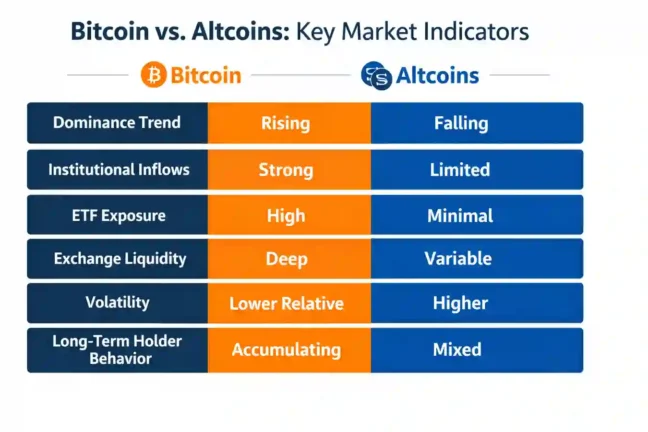
This divergence reflects capital consolidation rather than capital exit.
Money is not leaving crypto. It is concentrating.
Why Bitcoin Benefits First During Market Resets
Bitcoin maintains several structural advantages that reinforce its dominance during uncertain market phases.
Deepest Global Liquidity
Bitcoin’s trading volume exceeds that of any other digital asset. Large investors can enter and exit positions without causing excessive price impact.
This makes Bitcoin the preferred asset during volatility.
for you: Bitcoin Holds Near $67K as Weak Momentum Signals Fragile Market
Institutional Infrastructure
Bitcoin has the most developed ecosystem of institutional custody providers, regulated investment vehicles, and derivatives markets.
Binance Research noted in a recent market structure report:
“Bitcoin remains the primary institutional gateway into crypto markets due to its liquidity, maturity, and regulatory clarity.”
— Binance Research Report
This institutional infrastructure reinforces Bitcoin’s leadership position.
Proven Network Stability
Bitcoin’s operational history, security, and decentralization continue to inspire confidence among long-term investors.
Trust compounds over time.
Historical Cycles Show Dominance Peaks Precede Market Expansion
Bitcoin dominance moves in cycles. It rises during accumulation and deleveraging phases, then stabilizes before capital rotates outward into altcoins.
This sequence occurred in:
- 2019 accumulation phase before altcoin recovery
- 2020–2021 institutional expansion cycle
- 2022 deleveraging period following major market disruptions
The current environment aligns closely with early-stage structural reset phases.
Based on my own analysis across past cycles, Bitcoin dominance stabilization—not necessarily reversal—often marks the transition toward broader market recovery.
Patience is required. Timing matters.
Why This Matters
Bitcoin dominance rising confirms institutional capital is prioritizing liquidity, stability, and structural strength, reinforcing Bitcoin’s leadership role while preparing the broader crypto ecosystem for its next expansion phase.
What This Means for Traders
- Bitcoin continues attracting the majority of institutional inflows.
- Altcoin weakness reflects liquidity reset, not permanent structural decline.
- Dominance stabilization often precedes broader altcoin recovery phases.
- Monitoring BTC.D trends helps identify cycle transitions and capital rotation.
Conclusion
Bitcoin dominance reaching cycle highs reflects a structural capital consolidation phase driven by institutional inflows, derivatives deleveraging, and liquidity prioritization. While altcoins face near-term pressure, historical patterns show these reset phases strengthen market foundations and prepare the ecosystem for future expansion. Bitcoin’s leadership during this transition reinforces its position as the core reserve asset of the crypto economy.
Disclaimer: The information provided for informational purposes only and does not constitute investment advice. Always do your own research before making financial decisions. Follow us for more updates from CoinSpectra.in

Potaraju Ramesh
Potaraju Ramesh is the Founder and Lead Market Analyst at CoinSpectra.in, an independent digital publication focusing on cryptocurrency and Web3. Since 2017, he has been analyzing market cycles, on-chain data, and Indian regulatory frameworks. His editorial approach is built on transparency and data-driven neutrality, providing readers with the context needed to understand complex digital asset shifts.