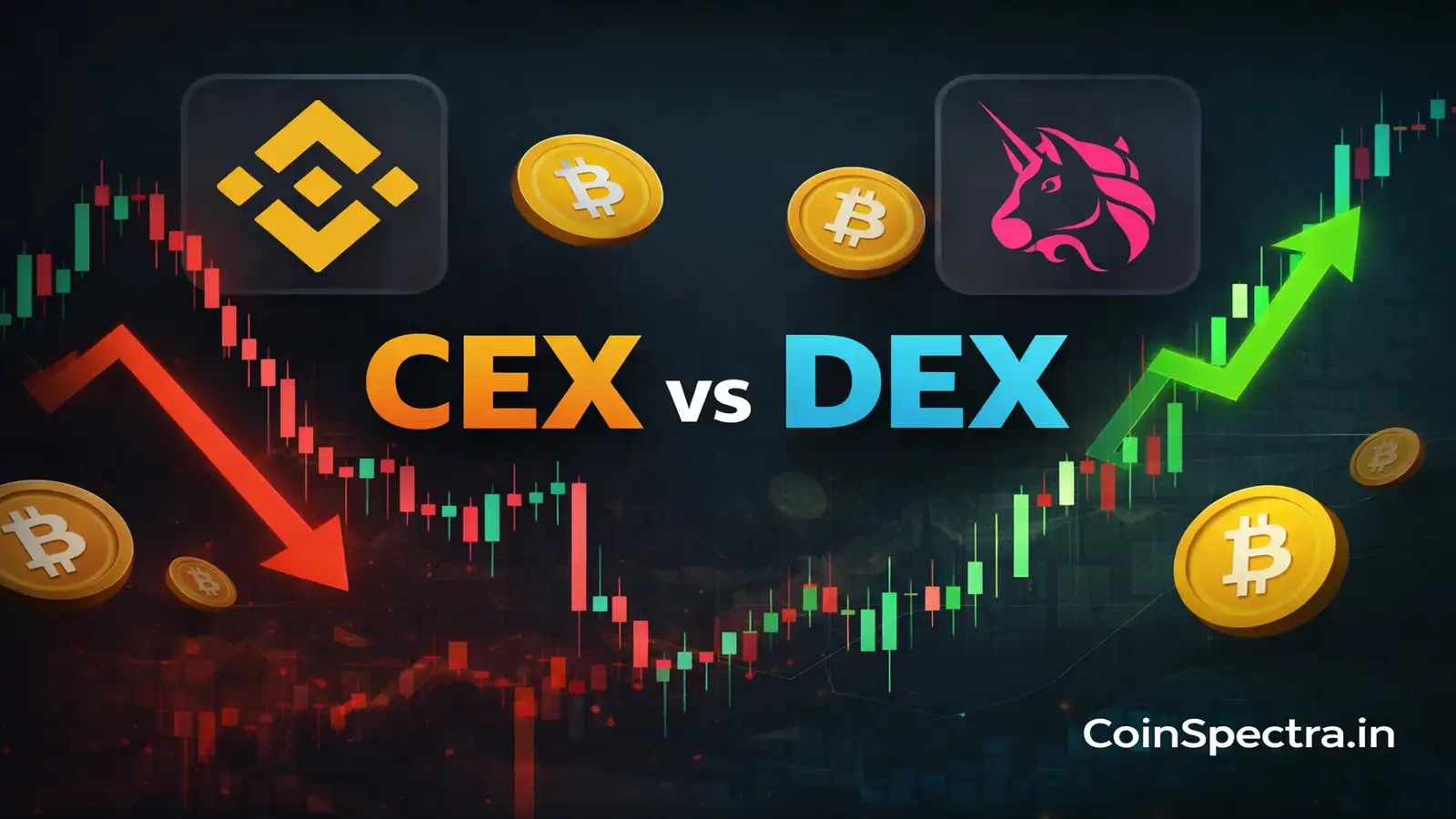
After testing both centralized and decentralized exchanges across multiple market cycles, one reality keeps resurfacing: where you trade — and where you custody can change your risk overnight.
From high-liquidity venues like Binance and Coinbase to on-chain protocols such as Uniswap, the structural differences are no longer theoretical. They directly affect execution speed, slippage, regulatory exposure, and asset control.
In 2026, the CEX vs DEX decision is not ideological. It is strategic.
Quick Summary:
- Centralized exchanges still control most global spot and derivatives volume.
- DEX trading share spikes during regulatory stress or exchange-related uncertainty.
- Custody risk differs sharply: exchange control vs self-custody.
- Most experienced traders now use both models — for different purposes.
What Is a Centralized Exchange (CEX)?
A centralized exchange is a company-operated trading platform where users deposit funds and trade through an internal order book. The platform holds custody of assets.
Put simply, when you buy Bitcoin on Binance, the trade often executes inside the exchange’s internal ledger before settlement touches the blockchain.
How It Works
- Account registration
- Identity verification (KYC)
- Asset deposit into custodial wallets
- Order matching via centralized engine
I have used centralized exchanges extensively for high-volume trades and futures positions. The liquidity depth and tight spreads on major pairs remain unmatched. Execution is immediate. Slippage is minimal on liquid pairs.
That speed matters when volatility spikes.
Brian Armstrong, CEO of Coinbase, stated during earnings commentary that “trust and compliance are essential for bringing institutions on-chain.” Institutions demand regulatory clarity. Centralized venues provide that framework.
Strengths of CEXs
- Deep liquidity pools
- Advanced derivatives products
- Fiat on-ramps
- Customer support
But custody remains the core trade-off. Users do not control private keys. The platform does.
Also Read: Top Crypto Exchanges Ranked by Volume, Fees, and Security in 2026
What Is a Decentralized Exchange (DEX)?
A decentralized exchange runs on smart contracts. There is no intermediary holding your funds. Trades occur directly from your wallet.
Uniswap introduced the automated market maker (AMM) model, replacing traditional order books with liquidity pools. Prices adjust algorithmically based on supply and demand inside the pool.
Hayden Adams, Founder of Uniswap Labs, has said that decentralized finance ensures “permissionless access to global markets.”
When I first used a DEX, the difference was immediate. No account. No KYC. Wallet connection, confirm transaction, done. Funds never left my control except for the exact swap amount.
That autonomy is powerful.
How DEXs Operate
- Wallet connection (e.g., MetaMask)
- Smart contract execution
- On-chain settlement
- Liquidity pools instead of centralized order books
But execution quality depends on pool depth. On smaller tokens, slippage becomes noticeable fast.
Volume Data: Who Actually Dominates?
According to research from CoinDesk and on-chain analytics platforms such as Dune Analytics, centralized exchanges still handle the majority of global crypto spot and derivatives volume.
However, DEX market share has increased materially over recent cycles. During regulatory actions targeting centralized exchanges, on-chain volumes have historically surged.
When regulatory headlines hit, self-custody demand rises. I have seen this shift firsthand during high-stress news cycles. Funds move off exchanges. On-chain activity spikes.
The pattern repeats.
Custody Risk: The Structural Difference
The real debate centers on custody.
Put simply, CEX risk is institutional. DEX risk is technical.
The real debate centers on custody — who controls your assets and where the risk truly sits.
| Risk Factor | Centralized Exchanges (CEX) | Decentralized Exchanges (DEX) |
|---|---|---|
| Private Key Control | Exchange holds private keys | User holds private keys |
| Withdrawal Risk | Possible freezes during regulatory or internal issues | No centralized freeze mechanism |
| Counterparty Exposure | Yes — dependent on exchange solvency | No centralized counterparty |
| Smart Contract Risk | Minimal (internal systems) | Yes — vulnerable to contract exploits |
| Scam / Fake Token Risk | Lower due to listing controls | Higher — permission less listings |
Gary Gensler, Chair of the SEC, has repeatedly emphasized that crypto trading platforms “must come into compliance with securities laws.” That regulatory pressure primarily affects centralized operators.
DEX protocols, by contrast, often function as deployed code. Enforcement pathways differ significantly.
Risk is not eliminated on either side. It is redistributed.
Execution Costs: CEX vs DEX Breakdown
In practical terms, CEX trading costs are predictable. DEX trading costs fluctuate with network congestion and pool liquidity.
Execution determines profitability. The fee structure and liquidity depth on each model can materially impact returns.
| Cost & Execution Factor | Centralized Exchanges (CEX) | Decentralized Exchanges (DEX) |
|---|---|---|
| Trading Fee Structure | Maker–taker fee model | Liquidity provider fee embedded in swap |
| Spread on Major Pairs | Generally tighter due to deeper order books | Depends on pool depth |
| Gas / Network Fees | None (off-chain execution) | Yes, blockchain network gas required |
| Slippage Risk | Lower on high-liquidity pairs | Higher on low-liquidity pools |
| MEV Exposure | Not applicable | Possible on some networks |
In my own testing, large-cap token trades execute more efficiently on centralized venues due to deeper order books. Smaller-cap, early-stage tokens often appear first on DEXs.
Each model serves a different phase of a token’s lifecycle.
Also Read: MetaMask Debit Card Launch Marks Structural Shift in Crypto Payments
Institutional Adoption vs Retail Autonomy
Institutional traders gravitate toward centralized platforms due to:
- Regulatory clarity
- Audited custody systems
- Structured compliance
Retail users increasingly explore DEXs for:
- Early token access
- Self-custody control
- Yield opportunities
The two audiences behave differently, and that shapes liquidity distribution.
Bloomberg reporting has highlighted increasing institutional engagement through regulated custodians and centralized venues. At the same time, decentralized finance protocols continue to capture innovation and early liquidity.
The ecosystem is bifurcated but interconnected.
Why This Matters
Liquidity fragmentation between centralized and decentralized exchanges affects volatility, spreads, and systemic risk across the entire crypto market.
What This Means for Traders
- Use centralized exchanges for high-liquidity pairs and derivatives strategies.
- Use decentralized exchanges for early-stage token access and custody control.
- Avoid holding excess idle funds on any single platform.
- Evaluate counterparty exposure continuously.
Diversification across custody models reduces structural risk.
The Reality After Testing Both
After actively trading on centralized exchanges and executing on-chain swaps during volatile periods, one conclusion stands out.
Centralized exchanges optimize for speed and scale.
Decentralized exchanges optimize for autonomy and resilience.
Neither replaces the other.
Professional traders increasingly combine both depending on strategy, size, and risk tolerance.
The CEX vs DEX debate is evolving into a liquidity allocation strategy rather than a philosophical divide.
Also Read: AI Gains Financial Autonomy as Machine Economy Enters Structural Shift
Conclusion
In 2026, centralized and decentralized exchanges coexist within a layered crypto market structure. Liquidity depth, regulatory exposure, custody control, and execution cost all influence venue choice.
The smarter approach is not choosing sides. It is understanding when to use each.
Disclaimer: The information provided for informational purposes only and does not constitute investment advice. Always do your own research before making financial decisions. Follow us for more updates from CoinSpectra.in