

Bitcoin miners are shutting down rigs at one of the fastest rates seen since the 2021 China ban, as a widening gap between production costs and market prices forces the industry into a painful but familiar reset. In early 2026, Bitcoin is trading near $64,000–$67,000, while the average cost to mine a single coin has climbed above $90,000, pushing many operators deep into negative margins.
The result is a wave of curtailments, facility shutdowns, and strategic pivots most notably toward artificial intelligence (AI) and high-performance computing (HPC) that is reshaping the mining landscape and temporarily reducing Bitcoin’s total computing power.
While the immediate picture looks bleak for miners and mining stocks, analysts say the broader network is behaving exactly as designed.
Table of Contents
A Business Model Under Strain
In most industrial sectors, producing an asset at a 30–35% loss would be unsustainable. Yet Bitcoin mining operates under a different set of incentives. Miners cannot individually control output; instead, they compete for block rewards governed by protocol rules. When prices fall below production costs, inefficient players are forced out not by regulators or bankruptcy courts, but by math.
According to industry estimates and mining profitability models, all-in production costs now range between $87,000 and $95,000 per BTC, factoring in electricity, hardware depreciation, hosting, and overhead. With Bitcoin below that threshold for several weeks, many mid-tier and high-cost miners are effectively subsidizing operations by selling reserves or raising capital.
“This environment of hash-price compression is inherently unsustainable,” one mining analyst noted, “but it’s also a necessary phase of the Bitcoin lifecycle.”
Bitfarms Signals a Structural Shift
The most striking signal of stress came from Bitfarms, a major North American mining firm listed on Nasdaq. In late 2025, the company announced plans to fully exit Bitcoin mining by 2027, beginning with the shutdown of its 18-megawatt Washington State facility.
Rather than mothballing the site, Bitfarms is converting it into an AI data center built around liquid-cooled Nvidia GPUs, capable of supporting roughly 190 kW per rack. The project is expected to be completed by December 2026.
“We believe converting just our Washington site to GPU-as-a-service could yield more net operating income than we’ve ever achieved through Bitcoin mining,” —CEO Ben Gagnon said
The decision followed a $46 million loss in Q3 2025, nearly double the company’s loss a year earlier. Investors initially welcomed the pivot, pushing Bitfarms shares higher on the day of the announcement, underscoring a growing belief that AI infrastructure may offer more stable returns than proof-of-work mining during prolonged price downturns.
Winter Storms Accelerate the Shutdowns
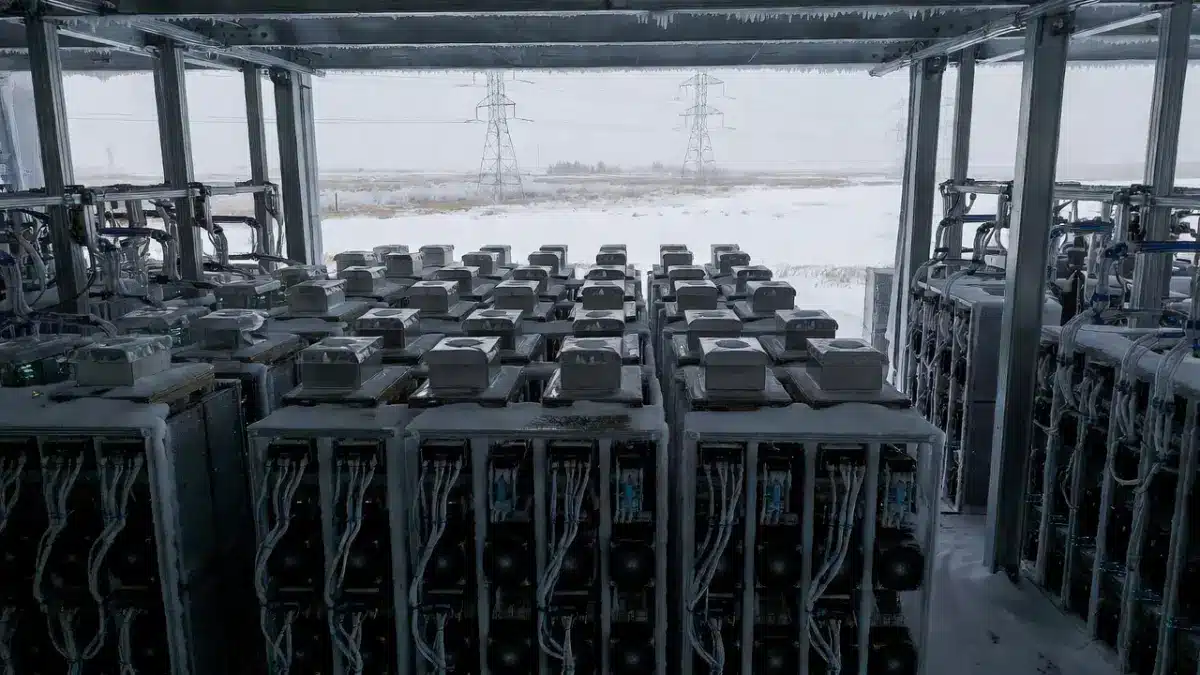
Nature compounded the industry’s challenges in January 2026. Winter Storm Fern swept across large parts of the United States, straining power grids—particularly in Texas, which has become a global hub for industrial-scale mining.
Because miners in Texas often operate as “interruptible load”, they are incentivized to shut down during periods of grid stress, selling electricity back to the grid at premium rates. During the storm, several major pools saw dramatic declines in hashrate.
- Foundry USA Pool reportedly lost up to 200 EH/s, a drop of roughly 60% at peak disruption.
- Luxor fell from around 40 EH/s to near 16 EH/s.
As a result, Bitcoin’s total network hashrate slid to a seven-month low near 663 EH/s, representing a 30–40% decline from late-2025 highs.
Block times stretched from the target 10 minutes to 12–14 minutes, setting the stage for one of the largest difficulty adjustments since 2021.
Difficulty Adjustment: Bitcoin’s Self-Correction
On February 8, 2026, the Bitcoin network is expected to implement a difficulty reduction of roughly 16–18%, lowering the computational effort required to mine a block.
This mechanism, hard-coded into Bitcoin’s protocol, is what allows the network to survive periods of extreme stress. As inefficient miners power down, the difficulty adjusts, restoring profitability for those who remain.
“High production costs don’t kill Bitcoin,” one long-time mining operator explained. “They force efficiency and strengthen the network.”
Historically, similar episodes have followed this pattern:
- 2021 China ban: Hashrate fell nearly 50%, followed by a rapid recovery.
- 2022 bear market: Miner capitulation preceded Bitcoin’s eventual bottom.
The current adjustment is expected to improve margins for miners with access to sub-$0.06 per kWh electricity and newer-generation hardware.
Older Rigs Go Dark First
The shutdowns are not evenly distributed. Industry data shows that older ASIC models, particularly Antminer S19-series rigs operating at 25–30 J/TH, are being switched off first. At current difficulty and power prices above $0.07/kWh, these machines struggle to break even unless Bitcoin trades well above $75,000.
By contrast, newer S21-class machines, operating near 17 J/TH, remain viable in regions with cheaper or renewable energy.
This dynamic is accelerating a long-running trend: consolidation around fewer, more efficient, and better-capitalized operators.
Mining Stocks Reflect the Pain
Publicly traded mining stocks have mirrored the operational stress. In early February:
- MARA Holdings fell roughly 9% in a single session.
- Riot Platforms declined between 10–14%, pressured by weather-related curtailments.
- CleanSpark dropped nearly 20%, despite its renewable energy focus.
Year-to-date, many mining equities are down 30–45%, amplifying Bitcoin’s price moves due to their operational leverage.
Even firms pursuing AI diversification, such as Core Scientific and Iris Energy, have not been immune, as investors weigh the execution risks of transitioning away from pure mining models.
Is the Network at Risk?
A falling hashrate often raises concerns about Bitcoin’s security, particularly around the risk of a 51% attack. However, analysts broadly agree that the current situation does not pose a systemic threat.
Mining remains geographically distributed, with no single jurisdiction or entity controlling a majority of hashpower. Moreover, difficulty adjustments ensure that security costs remain aligned with active participation.
In practical terms, the network is doing what it has always done during downturns: shedding excess, recalibrating, and preparing for the next phase.
Why This Matters
This episode is not just about miner losses or stock declines. It marks a structural transition in how Bitcoin mining intersects with global energy markets and emerging technologies like AI.
The miners that survive this phase are likely to be:
- More energy-efficient
- Less leveraged
- Better integrated with grid stability programs
At the same time, Bitcoin’s protocol continues to demonstrate its resilience, absorbing shocks without requiring bailouts, policy interventions, or centralized decision-making.
Looking Ahead
Short-term volatility remains likely. Reduced miner selling pressure could offer some price stabilization, but broader macroeconomic conditions and risk appetite will continue to influence Bitcoin’s trajectory.
For the mining industry, 2026 is shaping up to be a year of consolidation rather than expansion. For the Bitcoin network itself, it is another stress test, one that history suggests it is well equipped to survive.
Disclaimer: This article is for informational purposes only and does not constitute financial or investment advice. Readers should conduct their own research before making financial decisions.
Follow CoinSpectra.in for independent, data-driven coverage of Bitcoin, crypto markets, and digital infrastructure.