

Institutional investors slammed the brakes on digital asset accumulation this Monday. On April 27, 2026, U.S. spot Bitcoin and Ethereum exchange-traded funds recorded a staggering $313.6 million in combined outflows. This abrupt capital flight snapped a highly publicized nine-day inflow streak, signaling a severe shift in Wall Street sentiment. The exodus comes precisely as Bitcoin slips beneath the critical $77,000 support level, driven by mounting macroeconomic anxiety ahead of this week’s Federal Open Market Committee (FOMC) meeting.
What You Need to Know
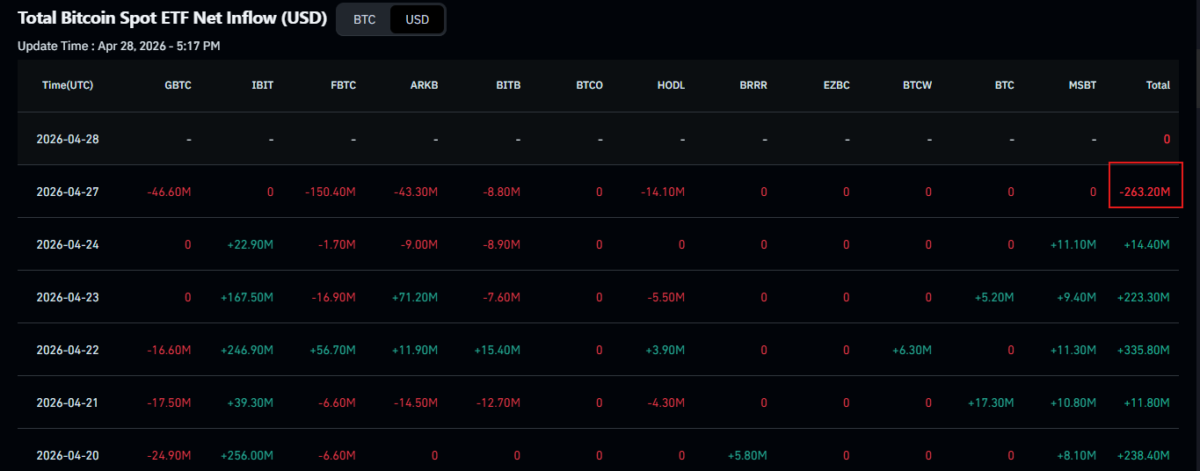
- Massive Capital Flight: Spot Bitcoin ETFs shed $263.20 million in a single day, while Ethereum spot ETFs mirrored the bearish trend with $50.40 million in net outflows.
- Fidelity Leads the Dump: Fidelity’s FBTC absorbed the heaviest blow, bleeding $150.40 million. Meanwhile, BlackRock’s IBIT recorded exactly zero flows, indicating a hard pause from the market’s largest institutional buyer.
- Macro Triggers: Surging inflation expectations (currently tracking at 4.8%) and plummeting consumer confidence have spooked traditional finance players out of risk-on assets.
- Technical Breakdown: Bitcoin has officially lost the $77,000 psychological floor. Market analysts are now eyeing the $73,000 zone as the next major structural support.
The ETF Exodus: Breaking Down the $313.6 Million Outflow
The institutional landscape shifted violently on Monday. After nearly two weeks of sustained buying pressure that previously injected over $2.1 billion into the market, the ETF narrative flipped.
Fidelity’s FBTC took the brunt of the damage. The fund recorded a massive $150.40 million exit, representing more than half of the total daily Bitcoin outflows. Grayscale’s GBTC, historically prone to consistent bleeding due to its higher fee structure, posted another $46.60 million loss. Ark Invest’s ARKB was not spared either, losing $43.30 million by the close of the trading day. Bitwise (BITB) and Valkyrie (BRRR) also saw minor capital flights.
| Indicator | Status | Impact |
| Fear & Greed Index | Fear (Flipped from Neutral) | High |
| ETF Net Flow | -$313.6M | High |
| BTC Price Action | <$77,000 | Moderate |
Put simply, the selling was broad and aggressive across almost all major issuers.
However, the most telling data point came from Wall Street’s heaviest hitter. BlackRock’s iShares Bitcoin Trust (IBIT) registered zero net flows. In the ETF world, a flatline day for a fund of IBIT’s size doesn’t necessarily mean trading stopped. It means the creation and redemption mechanics perfectly canceled each other out. Institutions aren’t blindly dumping their BlackRock holdings, but the aggressive dip-buying that characterized the first quarter of the year has absolutely vanished.
Top Crypto Exchanges Ranked by Volume, Fees, and Security in 2026
Ethereum Follows the Leader
Ethereum failed to decouple from Bitcoin’s downward trajectory. Spot ETH funds recorded a parallel $50.40 million in outflows.
While smaller in sheer dollar volume compared to Bitcoin, the Ethereum outflows represent a proportional institutional step back from smart contract infrastructure. Traders had previously hoped that recent network upgrades would insulate ETH from broader market turbulence. Monday’s data firmly invalidates that theory. When macroeconomic fear grips the market, institutions treat all digital assets as high-beta tech stocks. They sell first and ask questions later.
Macro Headwinds: Why Are Institutions Spooked?
You cannot view these ETF outflows in a vacuum. The crypto market is currently chained to the U.S. Federal Reserve’s interest rate policy, and the underlying data is flashing red.
Investors are hyper-focused on tomorrow’s FOMC meeting. The Fed is widely expected to hold interest rates steady between 3.5% and 3.75%. Under normal circumstances, a rate pause is priced in. But current conditions are far from normal.
Recent Consumer Price Index (CPI) indicators suggest that inflation expectations have unexpectedly ticked back up to 4.8%. This sticky inflation creates a nightmare scenario for Federal Reserve Chairman Jerome Powell. He cannot cut rates to stimulate the economy without risking runaway inflation. Conversely, maintaining high rates continues to crush corporate margins and consumer spending power.
In plain terms: The market is terrified of a “hawkish hold.”
If Powell takes the podium and signals that rates will remain elevated through the end of 2026, liquidity will continue to drain from risk assets. Institutional ETF buyers are front-running this exact scenario. They are derisking their portfolios, taking the massive profits generated during the Q1 run-up, and moving back into cash or short-term Treasury bills.
The Consumer Confidence Crisis
Adding fuel to the fire is the latest U.S. consumer confidence data. The index just plummeted to a grim 49.8.
This is a recessionary warning sign. When everyday consumers tighten their belts, corporate earnings drop, traditional equities suffer, and highly volatile assets like Bitcoin often take the first hit in the collateral damage. Wall Street algorithms are designed to sell risk when consumer confidence craters. The $313.6 million crypto ETF outflow is a direct mechanical response to this deteriorating macro backdrop.
AI Gains Financial Autonomy as Machine Economy Enters Structural Shift
Bitcoin Price Action: Losing the $77,000 Support
The sheer volume of ETF selling has fundamentally damaged Bitcoin’s short-term market structure.
Over the weekend, Bitcoin hovered precariously above the $77,000 level. Bulls attempted to build a consolidation base, hoping the nine-day ETF inflow streak would provide a permanent floor. Monday’s $263.20 million BTC outflow shattered that thesis. Spot selling on Coinbase and Binance accelerated as soon as the negative ETF data hit the terminal screens, triggering a cascade of long liquidations in the derivatives market.
Bitcoin sliced through $77,000 with high volume. It is currently attempting to find footing in the mid-$75,000 range.
If this level fails to hold, technical analysts agree that the $73,000 zone is the next critical line of defense. This area previously served as heavy resistance during the 2024 cycles and should theoretically act as strong support now. A break below $73,000 would officially invalidate the current bullish structure, likely ushering in a prolonged period of downward chop.
The Silver Lining: On-Chain Supply
Despite the institutional panic, on-chain fundamentals tell a slightly different story. Exchange balances for Bitcoin are currently sitting at multi-year lows.
While ETF participants—who largely represent traditional finance traders—are actively selling, long-term cryptocurrency natives are aggressively moving their coins off exchanges and into cold storage. This creates a fascinating supply divergence. The “paper hands” of Wall Street are shaking out, but the absolute supply of available Bitcoin continues to shrink. If the macro fears subside, the resulting supply shock could trigger a violent move to the upside.
Why This Matters
This $313.6 million outflow proves that digital assets remain highly sensitive to traditional macroeconomic indicators; the anticipated decoupling of crypto from the Federal Reserve’s monetary policy has not yet materialized.
What This Means
- Prepare for Volatility: The immediate hours surrounding tomorrow’s FOMC press conference will likely feature erratic, high-leverage price swings. Avoid over-leveraging until Powell’s tone is clearly established.
- Watch the $73K Level: If Bitcoin tests $73,000, monitor the spot order books. A strong bounce with high volume indicates the bottom is in. A slow, grinding bleed through this level signals further pain.
- Track BlackRock (IBIT): IBIT recording zero flows is a massive red flag. Watch tomorrow’s ETF data closely. If BlackRock joins Fidelity in active outflows, expect a rapid acceleration of the current market dump.
- Altcoin Bleed: Ethereum’s inability to hold support suggests that smaller-cap altcoins will suffer magnified losses. Capital preservation should be prioritized over aggressive dip-buying in the altcoin sector.
Conclusion
The era of effortless, up-only institutional buying has officially paused. The $313.6 million exit from Bitcoin and Ethereum ETFs serves as a stark reminder that Wall Street capital is mercenary. As inflation fears resurface and consumer confidence crumbles, the crypto market must now prove it can find an organic price floor without the daily crutch of ETF inflows. All eyes now turn to the Federal Reserve.
Disclaimer: The information provided in this article is for informational purposes only and does not constitute investment advice. Always do your own research before making financial decisions. Follow us for more updates from coinspectra.in