

U.S.-listed cryptocurrency exchange Coinbase is reportedly in early discussions with global derivatives platform Bybit regarding a potential strategic investment partnership, according to multiple industry reports published on March 14, 2026.
The talks center on Coinbase potentially acquiring a minority equity stake in Bybit, a move that could reshape competitive dynamics among global crypto exchanges while strengthening cross-border liquidity infrastructure.
If finalized, the partnership may create a regulatory bridge between U.S.-regulated crypto markets and offshore derivatives liquidity, a development with implications for market structure, institutional adoption, and global trading competition.
You Need to Know
- Strategic investment talks: Coinbase is reportedly exploring a minority equity stake in Bybit rather than a full acquisition.
- Regulatory pathway: The partnership could help Bybit access the U.S. market through Coinbase’s regulatory framework and licenses.
- $25B valuation context: Analysts estimate Bybit’s valuation near $25 billion, aligning with recent institutional investments in major crypto exchanges.
- Derivatives expansion: The move would deepen Coinbase’s exposure to global crypto derivatives markets, which dominate overall trading volume.
Coinbase and Bybit Explore Strategic Investment Partnership
Reports across several crypto media outlets suggest that Coinbase Global Inc., the largest publicly listed crypto exchange in the United States, has initiated discussions with Bybit, one of the world’s most active derivatives trading platforms.
According to industry sources cited by crypto journalist Wu Blockchain, the discussions involve Coinbase potentially purchasing an equity stake in the Dubai-licensed exchange.
Neither company has issued an official confirmation.
Still, the possibility of collaboration between a U.S.-regulated exchange and a global derivatives powerhouse has quickly drawn attention across the digital asset industry.
Strategic Context: A Shift Toward Exchange Alliances
The reported talks come at a time when the cryptocurrency industry is entering a new phase of exchange consolidation and infrastructure collaboration.
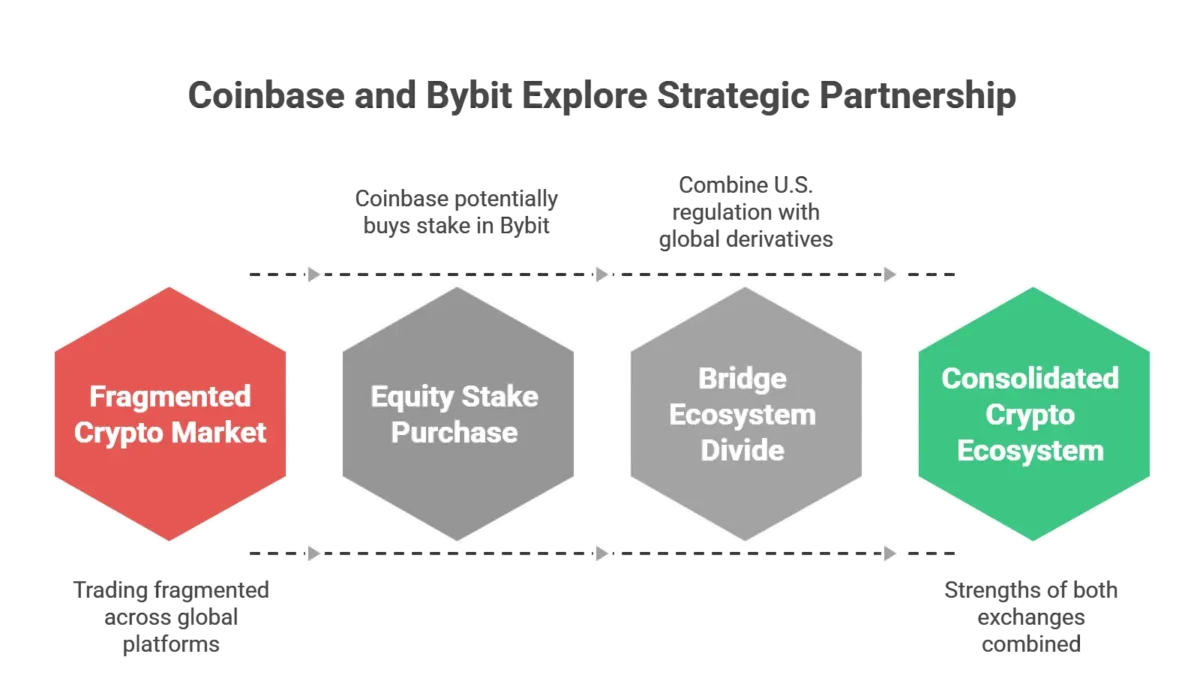
Over the past several years, crypto trading has become increasingly fragmented across global platforms. While regulated exchanges dominate institutional markets in jurisdictions like the United States and Europe, offshore platforms often capture the majority of high-volume derivatives trading.
Put simply, each ecosystem has strengths the other lacks.
A partnership between Coinbase and Bybit could help bridge that divide.
Understanding the Proposed Deal Structure
Equity Investment Rather Than Acquisition
According to early reports, the discussions involve a strategic minority investment, meaning Coinbase would acquire a stake in Bybit while both companies continue operating independently.
This structure is common in financial markets when firms want to cooperate strategically without merging operations.
The potential collaboration could include:
- Liquidity sharing between trading ecosystems
- Infrastructure integration for institutional clients
- Regulatory cooperation for cross-border market access
- Development of new derivatives trading products
Financial terms, stake size, and timelines have not yet been disclosed.
The Role of Regulatory Infrastructure
One key motivation behind the talks appears to involve regulatory market access.
Operating a cryptocurrency exchange in the United States requires navigating complex federal and state regulatory frameworks. Platforms must comply with oversight from agencies such as the U.S. Securities and Exchange Commission (SEC) and the Commodity Futures Trading Commission (CFTC), as well as state licensing requirements.
Many offshore exchanges including Bybit restrict U.S. users to avoid regulatory enforcement risks.
A partnership with Coinbase could provide a compliant pathway for expanded services.
As Coinbase Chief Legal Officer Paul Grewal previously stated regarding crypto regulation:
“Clear rules and transparent compliance are essential for the long-term growth of the digital asset industry.”
While the comment was not tied directly to the Bybit talks, it reflects Coinbase’s broader strategy of prioritizing regulatory clarity.
Also Read: CFTC Signals Shift Toward U.S. Perpetual Futures Framework
The Market Position of Coinbase
Founded in 2012, Coinbase has become one of the most influential companies in the global crypto sector.
The exchange serves millions of retail users and institutional investors, offering a wide range of services including:
- Spot cryptocurrency trading
- Institutional custody and prime brokerage
- Blockchain infrastructure tools
- Derivatives trading through international entities
Coinbase has also pursued an aggressive expansion strategy in derivatives markets.
In 2025, the company completed a $2.9 billion acquisition of the derivatives exchange Deribit, signaling its ambition to compete more directly with offshore platforms dominating global futures markets.
Industry analysts widely viewed the acquisition as part of Coinbase’s broader goal of building a comprehensive multi-asset trading platform.
Bybit’s Global Trading Dominance
Founded in 2018 by Ben Zhou, Bybit has rapidly grown into one of the largest crypto exchanges globally.
The platform is particularly known for its strength in:
- Perpetual futures trading
- High-liquidity derivatives markets
- Advanced trading infrastructure
- Institutional trading tools
Bybit consistently ranks among the top global derivatives exchanges by trading volume, often competing directly with industry leaders such as Binance and OKX.
The exchange has also taken steps toward regulatory legitimacy in recent years.
Bybit secured a full operational license from Dubai’s Virtual Assets Regulatory Authority (VARA), reflecting the company’s effort to expand within regulated jurisdictions.
Also Read: Coinbase Launches Regulated Crypto Futures Trading Across 26 European Countries
Valuation Estimates and Institutional Comparisons
Industry analysts estimate Bybit’s valuation near $25 billion, placing it among the most valuable crypto trading platforms worldwide.
The valuation mirrors recent institutional investment trends in the crypto exchange sector.
Earlier this year, Intercontinental Exchange (ICE)—the parent company of the New York Stock Exchange—took a minority investment position in OKX at a similar valuation level, highlighting growing institutional interest in digital asset trading infrastructure.
These developments suggest that traditional financial firms increasingly view crypto exchanges as critical components of future financial markets.
Market and Regulatory Implications
Bridging Regulated and Offshore Markets
One of the most significant implications of the Coinbase–Bybit discussions involves the potential integration of regulated and offshore trading ecosystems.
Historically, U.S.-regulated platforms and offshore exchanges have operated largely separate markets due to regulatory restrictions.
Strategic partnerships could gradually reduce that divide.
For institutional investors, such integration could improve access to deeper liquidity pools while maintaining regulatory compliance.
Liquidity and Market Efficiency
If collaboration between Coinbase and Bybit leads to shared infrastructure or liquidity pools, the crypto market could experience improvements in:
- Order book depth
- Price discovery efficiency
- Market stability during periods of volatility
Higher liquidity often attracts institutional trading firms and market makers, further strengthening the ecosystem.
Competitive Pressure Across the Exchange Sector
The potential partnership could also intensify competition among major exchanges.
Rivals such as Binance, OKX, and Kraken may accelerate their own partnerships or acquisitions in response.
The crypto exchange industry is gradually evolving toward structures similar to traditional financial markets, where strategic alliances and infrastructure sharing are common.
Why This Matters
A Coinbase investment in Bybit could mark a significant step toward integrating regulated U.S. crypto infrastructure with global derivatives liquidity, potentially reshaping competition among the world’s largest digital asset exchanges.
What This Means for Traders
- Deeper liquidity: Shared infrastructure could improve order execution and reduce spreads.
- Expanded derivatives access: New trading products may emerge through collaboration.
- Institutional inflows: Increased institutional participation could influence market stability and price discovery.
- Competitive innovation: Rival exchanges may accelerate product development in response.
Conclusion
The reported discussions between Coinbase and Bybit remain preliminary, and neither exchange has publicly confirmed the potential partnership.
However, the talks highlight a broader trend toward collaboration and consolidation within the global crypto exchange industry.
As regulatory frameworks evolve and institutional demand grows, strategic alliances may become an increasingly important mechanism for scaling liquidity, infrastructure, and market access.
For now, market participants will be watching closely for official statements from either exchange that could clarify whether the discussions progress into a formal agreement.
Disclaimer: The information provided in this article is for informational purposes only and does not constitute investment advice. Always do your own research before making financial decisions. Follow us for more updates from coinspectra.in.