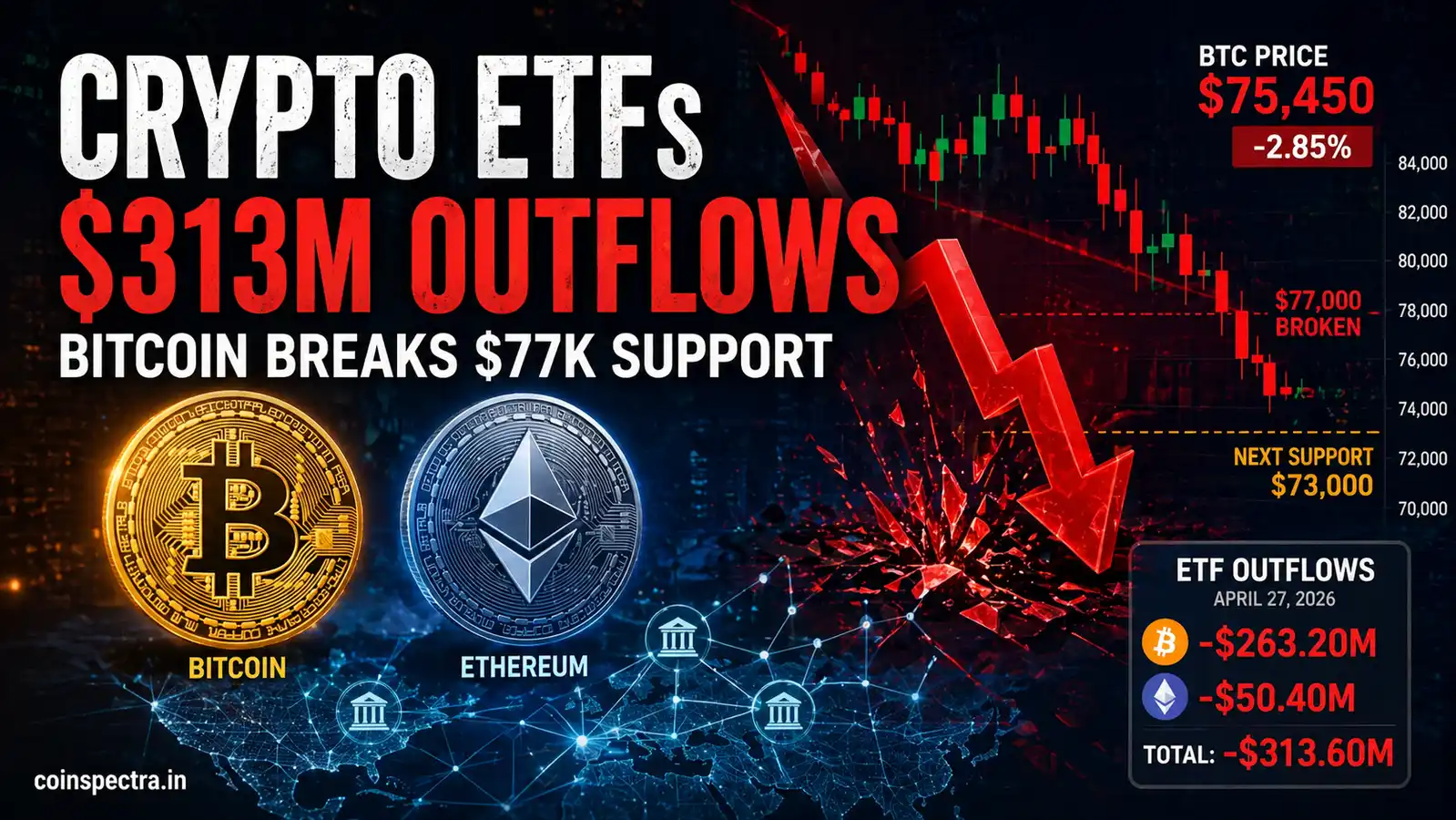

Bitcoin stabilized above $71,000 on March 13, 2026, leading a modest recovery across the cryptocurrency market as easing macro pressures and renewed regulatory dialogue in the United States boosted investor confidence. The move came as short positions were liquidated across derivatives markets while institutional traders absorbed supply during a period of cautious sentiment.
The global crypto market capitalization climbed to roughly $2.43 trillion, reflecting a measured rebound even as the widely watched Fear & Greed Index remained firmly in the “Fear” zone.
What You Need to Know
- Bitcoin traded between $71,500 and $71,800, gaining roughly 2% in 24 hours while maintaining about 58–59% market dominance, according to CoinMarketCap.
- Short liquidations accelerated the rally, with derivatives analytics from Coinglass showing $250M+ wiped out in bearish positions over the past day.
- Ethereum reclaimed the $2,100 level, while Solana led large-cap altcoins with gains near 3–4%, signaling selective rotation into high-activity networks.
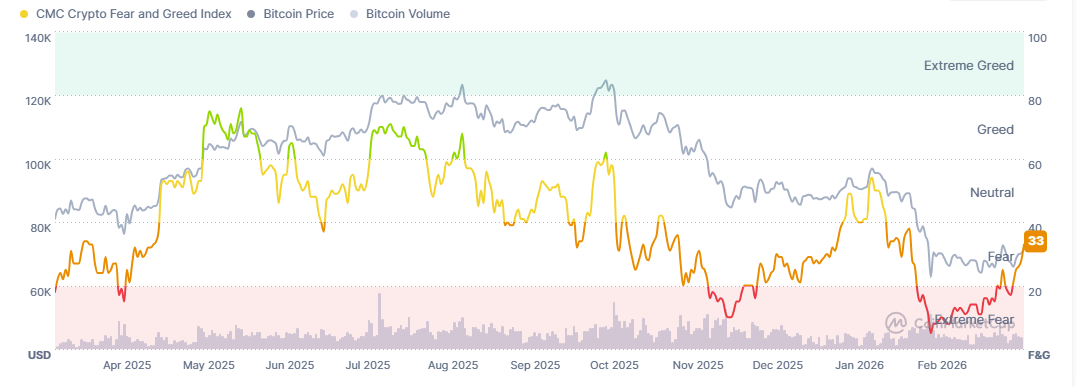
- Crypto Fear & Greed Index remained at 31 (Fear), indicating the rebound is still largely driven by institutional flows rather than retail enthusiasm.
Bitcoin’s $71K Recovery: Liquidity, Regulation and Macro Signals
The cryptocurrency market is currently balancing three forces at once: regulatory developments in the United States, easing macroeconomic pressure, and mechanical liquidity dynamics inside derivatives markets.
Bitcoin’s return above the $71,000 mark reflects a market attempting to rebuild stability after a volatile start to the month.
Having analyzed several market cycles while tracking flows for CoinSpectra, this pattern is familiar. Early recoveries often emerge when institutional liquidity quietly absorbs supply while sentiment remains subdued.
Data from CoinMarketCap shows Bitcoin trading near $71,500, with 24-hour trading volume surpassing $57 billion, confirming that the move was supported by genuine activity rather than thin liquidity.
Regulatory Coordination Signals Institutional Confidence
SEC–CFTC Dialogue Returns to Center Stage
One of the most closely watched developments for institutional investors came from Washington, where regulatory agencies renewed discussions about coordinated oversight of digital assets.
Officials from the U.S. Securities and Exchange Commission and the Commodity Futures Trading Commission have increasingly signaled the need for clear jurisdictional boundaries over cryptocurrencies.
For years, uncertainty around whether certain digital assets fall under securities law or commodities regulation has slowed institutional participation.
Put simply, large asset managers prefer predictable regulatory frameworks before allocating capital.
Analysts at Bloomberg Intelligence note that clearer regulatory coordination could reduce compliance risk for funds seeking exposure to Bitcoin and Ethereum markets.
Even incremental progress on regulatory alignment tends to improve sentiment. Markets often react quickly because institutional capital typically waits for policy signals before expanding exposure.
Also Read: CFTC Plans Crypto Taxonomy and DeFi Rules as U.S. Regulation Enters Critical Phase
Macro Pressures Ease as Oil Volatility Subsides
Beyond regulation, broader macroeconomic dynamics continue to shape crypto market liquidity.
Earlier this month, geopolitical tensions pushed energy prices higher, briefly rattling risk assets. But as crude oil retreated from recent peaks, global investors began cautiously returning to high-beta markets such as digital assets.
Crypto’s behavior during this period highlighted its evolving market role.
At times it trades like a speculative asset. At other moments, particularly when liquidity expectations shift it behaves more like a macro hedge or alternative risk asset.
The stabilization in oil markets reduced one major source of uncertainty, allowing capital to rotate back into cryptocurrency markets.
Short Squeeze Dynamics Accelerate the Rally
Liquidations Shift Momentum
While regulatory optimism and macro stabilization provided the narrative backdrop, the immediate price movement was largely mechanical.
Derivatives data from Coinglass indicates that more than $250 million in short positions were liquidated across crypto markets in the past 24 hours.
When bearish traders are forced to close leveraged positions, they must buy back the underlying asset—creating sudden upward pressure.
This type of short squeeze frequently accelerates rebounds during volatile periods.
Market veterans often view these liquidation cascades as signals that bearish positioning has become overcrowded.
Once those positions unwind, the market can move sharply in the opposite direction.
Ethereum and Altcoins Show Selective Strength
Bitcoin remains the dominant force in the market, controlling roughly 58–59% of total crypto capitalization, according to CoinMarketCap.
But altcoins are beginning to show signs of life.
Ethereum climbed back above $2,120, supported by steady network usage and continued interest from institutional investors exploring staking-enabled exposure.
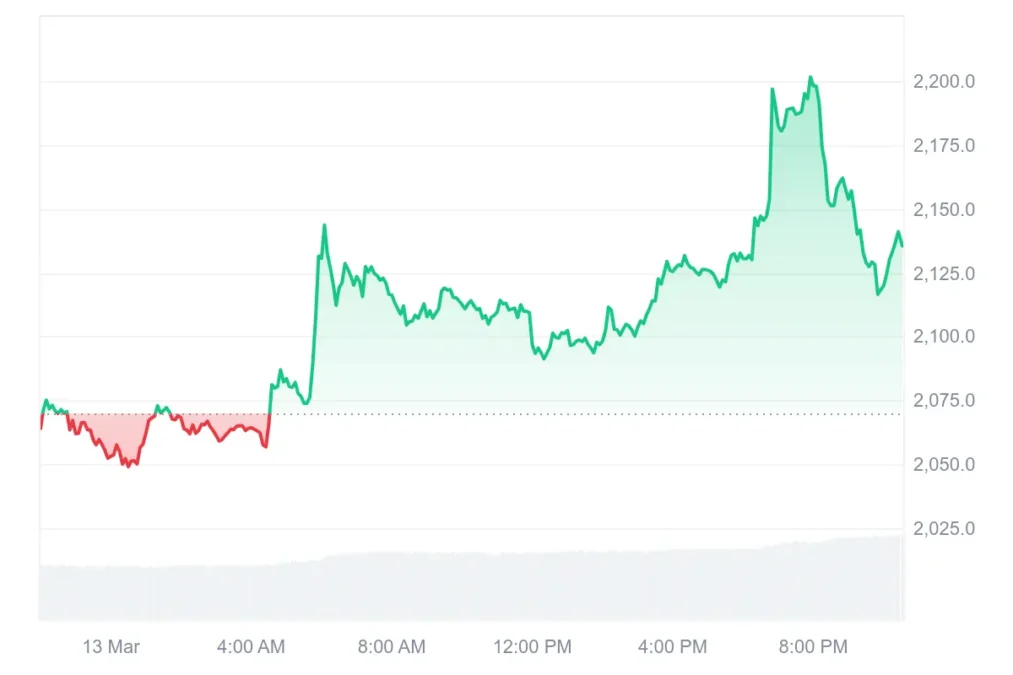
Meanwhile, Solana emerged as one of the strongest performers, gaining more than 3% to trade near $89–$90.
Network metrics help explain the move.
Solana’s total value locked (TVL) currently sits near $6.9 billion, while derivatives open interest has risen to roughly $5.4 billion, indicating that traders are increasingly positioning around the asset.
These indicators suggest that selective capital rotation into high-activity networks may be underway, though the broader market remains Bitcoin-led.
Also Read: Bitcoin Holds Near $70K as ETF Inflows Surge Amid Oil-Driven Inflation Risks
Sentiment Still Signals Caution
Despite the price rebound, market psychology remains cautious.
The Crypto Fear & Greed Index from Alternative.me sits at 31, firmly within the Fear zone.
This divergence between rising prices and cautious sentiment is not unusual.
In fact, many long-term investors view such conditions as typical of accumulation phases, when institutions gradually build positions while retail traders remain hesitant.
In plain terms, prices are rising—but the broader market is not yet convinced.
Why This Matters
This rebound tests whether the crypto market can sustain momentum without a single dominant catalyst, relying instead on improved liquidity conditions, regulatory signals, and derivatives positioning.
If Bitcoin can maintain strength above key support zones, broader market participation may follow.
What This Means for Traders
- Watch the $73,000–$74,000 resistance zone for Bitcoin. A sustained break could open the path toward $75,000.
- Short-liquidation rallies often fade quickly, so monitoring derivatives funding rates remains essential.
- Ethereum remains a balanced exposure, benefiting from staking yields and network activity.
- Solana momentum looks constructive, though traders should watch open interest and volume closely.
Conclusion
The cryptocurrency market ended the day on firmer footing as Bitcoin held above $71,000, supported by improving macro conditions, renewed regulatory dialogue, and a wave of short liquidations across derivatives markets. Whether this rebound evolves into a sustained recovery will depend on institutional flows, regulatory clarity, and the market’s ability to rebuild conviction in the days ahead.
Disclaimer: The information provided for informational purposes only and does not constitute investment advice. Always do your own research before making financial decisions. Follow us for more updates from CoinSpectra.in.